

 This article is part of the Alyx Project. This article is part of the Alyx Project.
|
| The subject of this article is featured in the new Half-Life: Alyx; therefore, its content is subject to change as more information about it is added. |
 This article would greatly benefit from the addition of more images. This article would greatly benefit from the addition of more images.
|
| To illustrate the article add one or more relevant images or upload them from canonical / official sources. For more instructions visit Half-Life Wiki:Images. |
- "Oh my God... Striders really tore the hell out of this place..."
- ―Alyx Vance[src]
The Strider is a large three-legged arthropod synth, armed with both a pulse minigun and warp cannon on its hull. They serve as the Combine's main heavy ground assault unit.
Overview
Striders are comprised of two components: their head and the three long legs supporting it. A strider's body is covered in a smooth brown carapace. On the head of the Strider is a rapid-firing pulse cannon that can swivel 180° horizontally and vertically in front of it. On it's belly, a heavier warp cannon hangs below. Exhaust ports are visible behind and on top of it's body, likely to release heat.
The striders three long legs are attached to it's body on it's left, right, and behind. These legs are divided into two sections: one shorter part attached to the body, and a longer part that is in contact with the ground. The latter is tipped with sharp spikes and a rosette of finer, hair-like spines. These legs are both maneuverable and powerful can be bent around the joint to allow the strider to drop it's body to lower heights.
Like all synths, striders blur the line between machine and organic components. Few is known about it's inner workings, but the strider does possess organic components such as muscle fibers, a spine, and a brain. Striders are incredibly vocal creatures; they use vocalizations to express pain, aggression, or even a cry of death, giving them an almost animalistic image.
According to Ted Backman, Striders that are seen on Earth are not biological creatures with cybernetic implants but, rather, synthetic copies of their natural counterparts that were retrofitted for the needs of the Combine. Backman states that Striders are scanned in their natural environments by the Combine and the data acquired is used to build their synthetic version that is used for the Combine war machine, as well as maintenance and building.
Construction Strider
A new variant of the Strider is introduced in Half-Life: Alyx; this version, however, possesses no offensive capabilities and was redesigned to aid in engineering and maintenance.
A Construction Strider possesses a mechanical platform attached to their main body, from which Combine Workers operate. The platform consists of three devices; a mechanical torch arm, which is used for welding work; binoculars, and a machine of unknown function, all of which are operated by Combine Workers. Mechanical legs connecting the platform to the strider also keep the platform levelled and prevent Workers from falling off.
Constructions striders were modified in several ways; their legs have been enhanced with augmentation devices to aid with roof climbing and improve balance, their warp cannon was replaced with a connector; which is used to move and connect large cables to Combine devices on rooftops, as shown in the first section of the game; and their pulse cannons were also replaced with a single large robotic eye.
Construction striders appear to have a very firm and heavy walk, apart from the more soft and slow walk from normal striders, this behavior may be due to the augmentation devices attached to their legs. They are observed to cause infrastructural damage as they walk.
Application
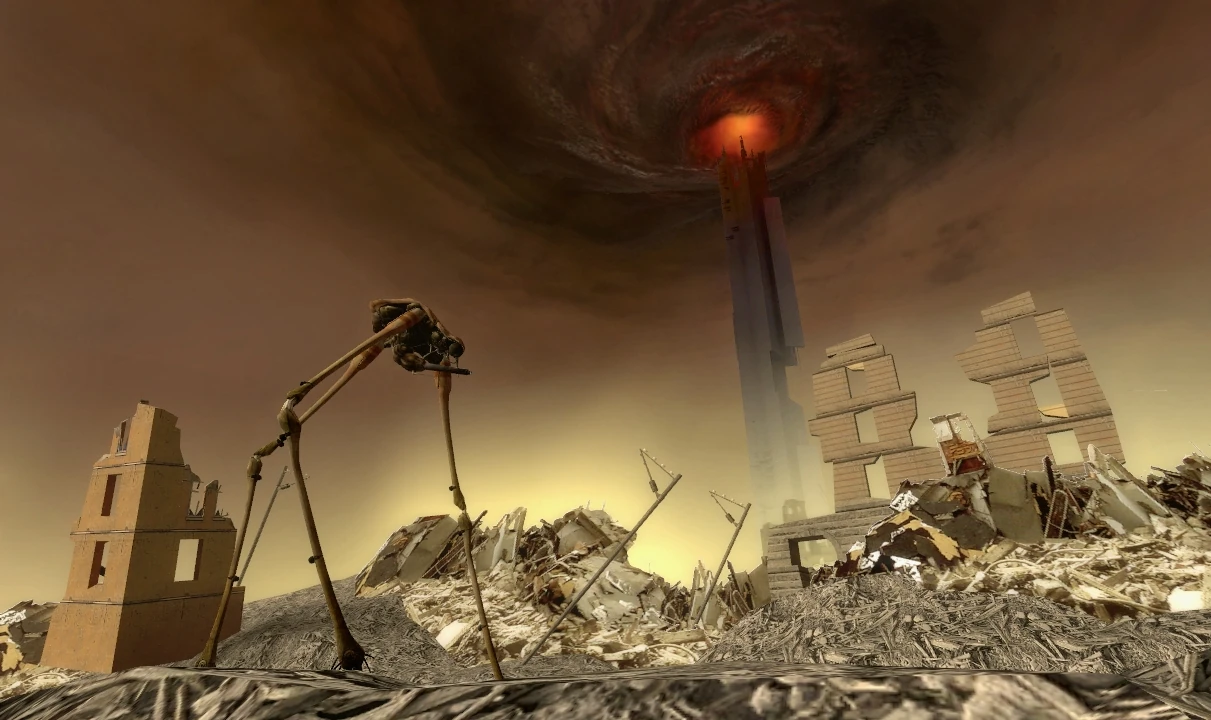
A Strider among City 17 rubble.
Striders are the largest and arguably most destructive of the Combine's ground units stationed on Earth. They fire their pulse gun at enemies below, picking them off one-by-one. A single burst is enough to kill a normal human with a few shots. Their most dangerous weapon is the warp cannon hanging from their abdomen; it fires a powerful burst of Dark Energy that warps light around it as it fires. This force is powerful enough to destroy structures such as buildings and vaporize any enemy caught in the crossfire. Their three powerful legs are each equipped with spikes and can strike down with powerful force, impaling anything it catches.
Striders are often deployed as support units for Overwatch soldiers and with each other to control an area. They are transported to and from combat zones by Combine Dropships, folding their legs for ease of transport. Striders patrol their territory with great zeal, firing upon anything that moves. It's not uncommon for areas guarded by striders to be reduced to rubble as their warp cannons destroy any surrounding structure. Despite their size, they have remarkable maneuverability; striders are able to squeeze into and clear out tunnels by extending their legs wider apart and lowering their body. In this position, striders can move exceedingly fast due to weight being spread out and their center of gravity lowered, and can move through tunnels quickly or sprint across open battlefields while firing at enemies.
In open areas, Striders are often accompanied by Hunters which act as escorts that destroy smaller targets and potential threats to the Strider. During the Combine offensive against White Forest, Striders are used to destroy the outer buildings surrounding the Resistance base, including the Magnusson Device teleporters.
Appearances
Half-Life 2
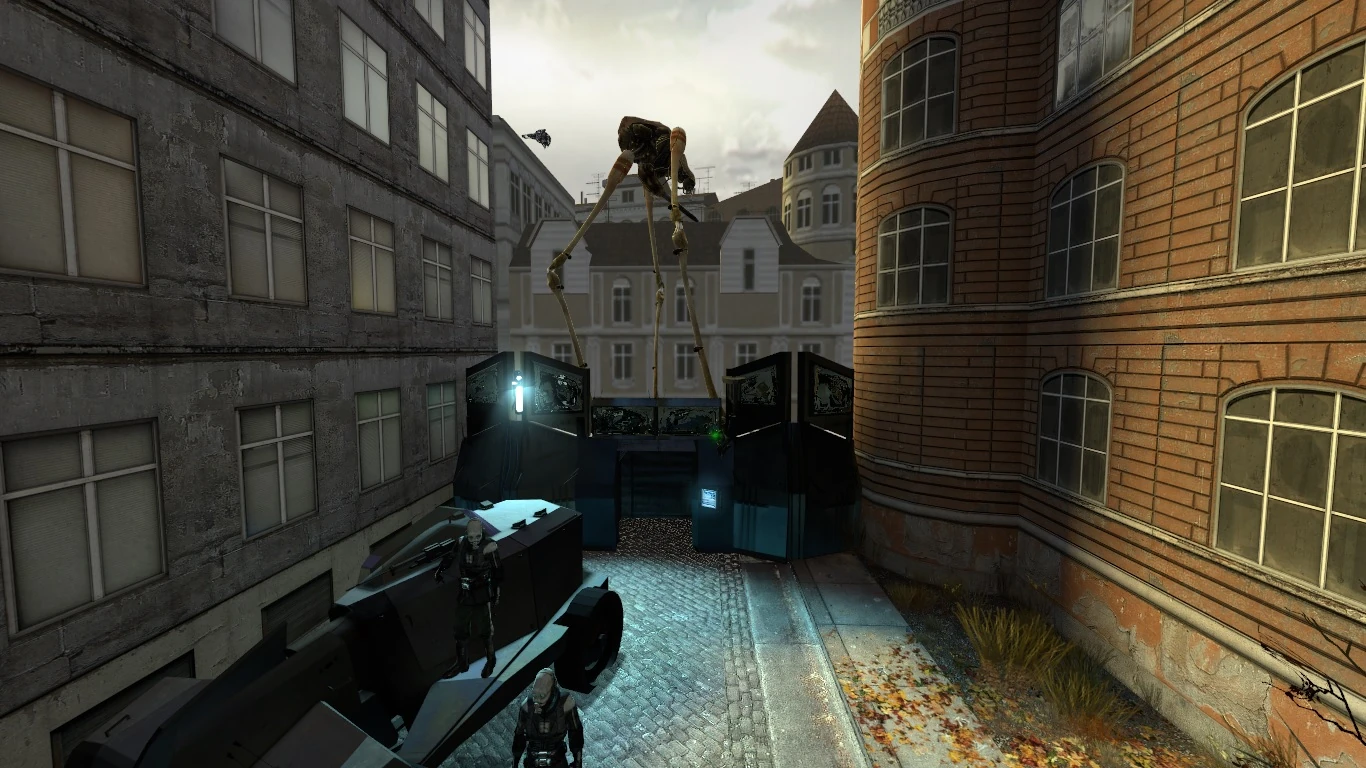
A Strider as seen for the first time in Half-Life 2.
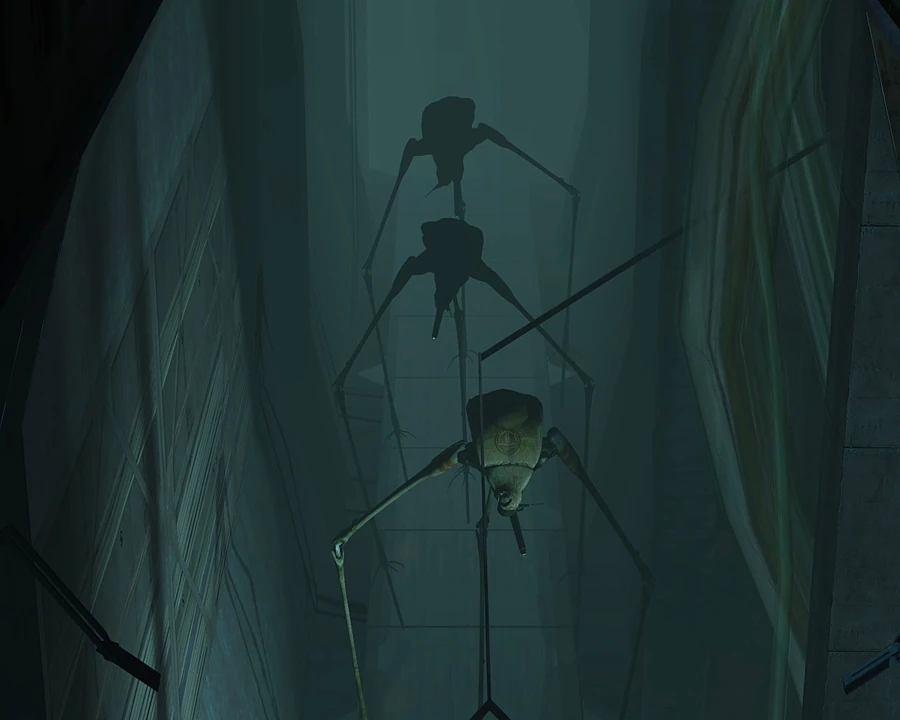
Striders walking in the Citadel.
A Strider is first glimpsed walking along a barred street with a City Scanner some time after leaving the Trainstation Plaza. They will not be seen again until Gordon returns to City 17 post the Uprising, in which they are used to kill Resistance fighters and demolish structures.
Striders are encountered extensively during the battle for the Overwatch Nexus. As Gordon descends from the building's rooftop back to the ground floor, multiple striders can be seen engaged in battle with Resistance fighters. When Gordon leaves the area, a strider pursues him as he flees into a building. Shield scanners are then deployed in order to notify the strider of his location inside.
As Gordon progresses closer to the Citadel, striders become much more prominent. Gordon takes out the striders and Overwatch soldiers in the area with help from the rebels and reunites with Barney and Dog, the latter of whom helps him enters the Citadel.
When Gordon fights his way in the Citadel, a strider is deployed to stop him at a point and killed. Striders are later seen inside the Citadel as Gordon makes his way into Breen's office via a personal carrier.
Half-Life 2: Episode One
Gordon and Alyx encounter striders inside the citadel as they march along a pathway. A damaged Dropship carrying a striders appears afterwards and crashes into said pathway a few seconds later. After Gordon and Alyx manage to find their way to the surface, Alyx sees the rubble and notes that striders have destroyed the area. A strider can be seen patrolling in the distance at this time.
A strider is encountered directly by Gordon at the Technical Trainstation as it attempts to prevent Gordon and Alyx from leaving the city. Gordon succesfully defeats it and finally leave City 17 via train with Alyx.
Half-Life 2: Episode Two
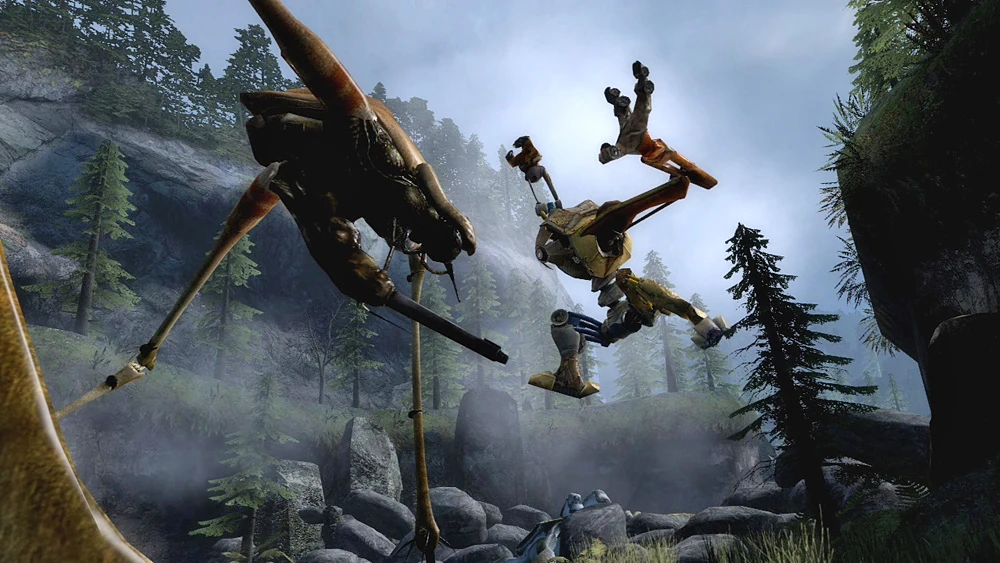
Dog about to prove his value against a Strider, as seen in the Episode Two trailer.
Striders are first seen among a Combine convoy walking to White Forest as the Combine regroup and prepare to assault White Forest. Sometime later, a strider can be seen being carried by a dropship before White Forest sentries take them down. Gordon and Alyx encounter the wreckage as they near White Forest, but to their surprise the strider survives and awakens. Fortunately, Dog arrives in the nick of time and attacks the strider. The resulting battle sees Dog overpowering the strider, maiming it, and finally killing it by removing it's brain.
Striders play a final key role in the Combine's last attempt to destroy White Forest and prevent the rocket launch, in which they are deployed en masse aided by Hunters. To defeat them, Gordon must use the Magnusson Device; a device invented by Arne Magnusson that can instantly kill striders upon being attached to their body and shot. Using the Gravity Gun to launch these devices, Gordon successfully destroys these incoming striders and deters the offensive as well as guarantees the rocket's successful launch.
Half-Life: Alyx
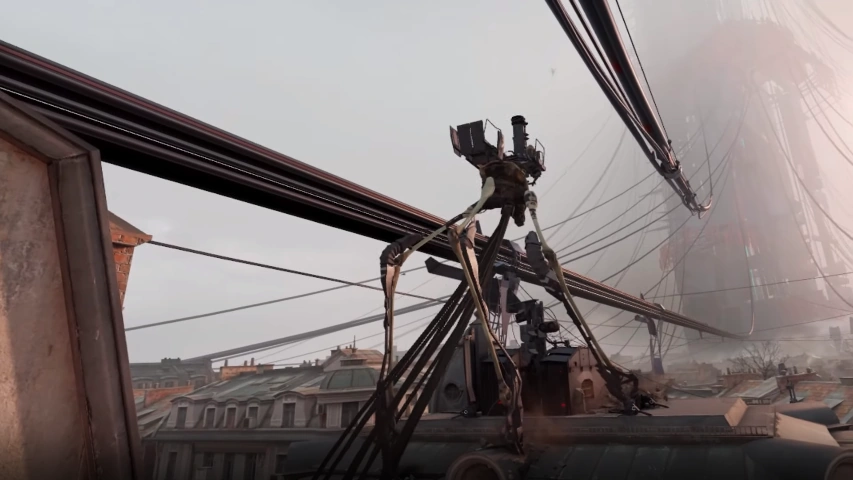
Multiple non-hostile Striders make an appearance during the first section of Half-Life: Alyx.
- A Strider is first seen in the background from the platform that Alyx initially spawns on, along side multiple Hunter-Choppers.
- Later on, whilst atop the adjacent balcony, a Strider can be seen mounting a rooftop and plugging in a combine cable. This damages the clay shingles closest to Alyx.
- On the catwalk above the a playground based off that from Half-Life 2, a Strider passes down the street, destroying Russell's drone.
After crashing the Vault and while looking for a way in, Alyx encounters two Combine Soldiers standing next to an apparently de-activated Strider, with one of the soldiers trying to kick it to wake it up again, only for Overwatch to tell him to stop. Alyx dispatches the soldiers and confirms the Strider is not working: Russell remarks that it would be terrible if it came back to life. He was proven right, as moments after Alyx reactivates a power generator for an elevator, the Strider abruptly comes to life and begins chasing her through the wreckage. After fighting off some more Combine soldiers while evading the Strider, Alyx discovers a Combine gun which she uses to destroy it.
Tactics
Striders are tough enemies with the ability to deal a lot of damage. It is important to utilize cover when facing them as their pulse gun can quickly reduce the player's health with just a few shots. They will typically fire in front of the player before orienting their aim towards them, giving the player a few seconds to get behind cover. Striders fire in bursts with a short cooldown between firing cycles giving the player a short window to utilize.
The most effective conventional weapon against striders is the RPG; it takes 5 rockets kill one in Easy mode. Using rockets can ensure reliable hits from relative safety by steering them towards the strider with maximum cover. Grenades, MP7 grenades, and the pulse rifle's secondary fire can work but do only half the damage of a rocket and require more accuracy. Striders tend to ignore all projectiles launched at them, focusing on attacking the player instead. They also move in preset patterns so their movements can be predicted, This, conjunction with cover and timing between the attacks, can be utilized to ensure you deal damage to it without it hitting back.
Striders will occasionally fire their warp cannons from behind cover at the player. Unlike it's pulse gun, this weapon has an audible cue in it's wind-up. Keep a lookout for the sound as well as the trademark blue line that appears between the cannon and it's target. A good rule of thumb is to move from your current position of cover as it's likely firing at you. When firing it's cannon, a strider cannot attack with it's pulse gun and will stand still, giving another window of attack.
In one section after leaving the Overwatch Nexus, shield scanners will assist a strider as you enter a building. The scanners will identify your location and blind you to the soldiers within, so take them out when they spawn and avoid windows where the strider might get a shot at you.
Only one strider is encountered in Episode 1, near the end of the game. This requires the player to traverse some obstacles before getting to a location where RPG ammo is readily available; keep to cover until you reach the ammo crate. This strider fires at a faster rate but has it's damage reduced so hits will be harder to avoid but not be as severe to the player.
In Episode 2, striders will be encountered in the final battle for White Forest. The player will be given unlimited Magnusson devices that can be launched to a strider's body then shot to instantly kill them. Striders in this section will ignore the player unless a device has been successfully attached, so focus should first be given to the Hunters that are escorting the strider as they can destroy the Magnusson devices before you can attach them. Once a device is attached, a strider can be taken out instantly by shooting the attached Magnusson device.
Behind the scenes
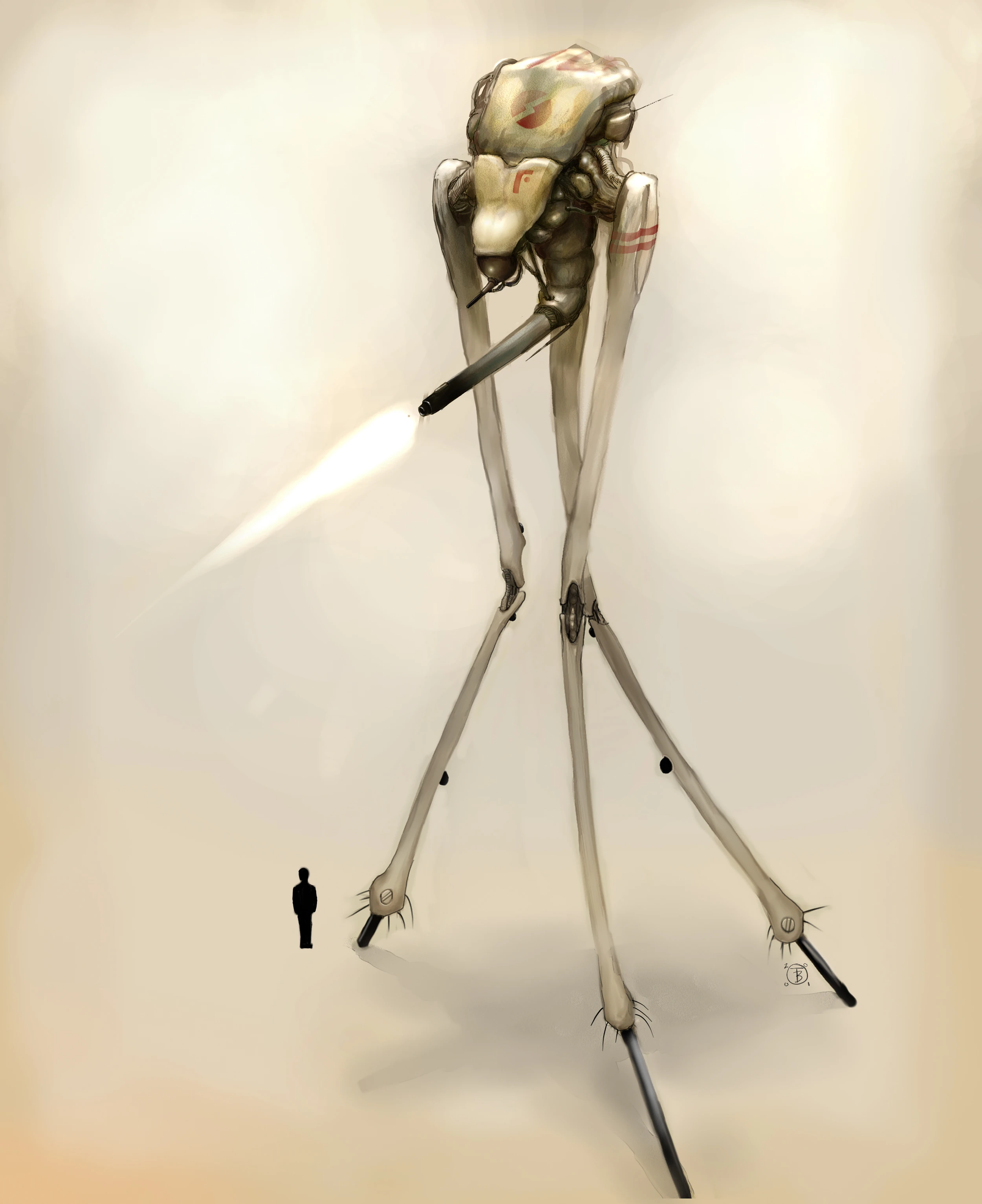
Concept very similar to the final version, dated 2001.
- Valve's Bill Fletcher used a giraffe/gorilla combo as animation reference for the Strider. He wanted the creature to capture the gracefulness of a giraffe and stomp and lead with its elbows like a gorilla when it walks, to convey a simian power.[2]
- During the development of Half-Life 2, developers were also working on the Crab Synth's concept art and designed the Attack Synth where its legs look very similar to the strider's but more thick.
- At some point in Half-Life 2’s development, the Strider was white, like the Combine Super Soldier, the Combine Assassin or the Overwatch Elite.[2]
- Early concepts depict the Strider with different heads, such as one only consisting of a cannon.[2]
- Several early iterations also bore miscellaneous markings, notably a maroon circle with a "Z" or a lightning bolt in the middle, and some sort of L with a small dot in the opposite angle.[2]
- It was originally to be met in the Coast levels, at least near the Air Exchange.[2]
- According to one of the concept art pictures featured in Raising the Bar, the Strider's current design was already defined as early as in 2001 (as seen in the date in Ted Backman's signature).[2]
- As seen in the Half-Life 2 Beta source code, the Hopwire Grenade was originally to be the weapon of choice against Striders,[3] replaced in Episode Two by the Magnusson Device. This is confirmed in the Episode Two commentary, in which Valve's Joshua Weier states that the Magnusson Device "started life as a Half-Life 2 weapon called the Hopwire".[4]
- As seen in the playable Half-Life 2 Beta, it was at some point possible for the player to assault Striders, ride them and take their gun after killing them. Noclipping to the Strider's head, then pressing the Use key results in the player seeing through the creature's eyes. At that point the only thing to do to free oneself is to kill the creature, for instance with the RPG (as the only way to kill a Strider in the playable Half-Life 2 Beta is by standing inside its head), or reload the game. When killing it, the Strider collapses, releasing the player. At that point, the red ERROR model appears. When walking through it, the player acquires the Immolator. This suggests the Immolator acts here as a placeholder for the Strider's warp cannon, and that rescuing it was at some point considered, a role that the Combine Guard Gun was already filling. As a side note, the Immolator worldmodel exists and should appear instead of the ERROR model.
- The Strider appears in two E3 maps, "
e3_strider" and "e3_c17_02". In the first map, several Striders were to chase gas mask Rebels through ruined streets, and one of the Striders was to destroy an arch building.[5] In the other map, more recent, similar events were to occur, with a tram passing by in the middle of the road. The reused arch building was also to be destroyed the same way. Parts of "e3_c17_02" were reused in "d3_c17_07" (the arch building) and "d3_c17_13" (the street, the tram tracks and the shelter).
- The Strider is an indirect successor to the Combine Super Soldier.[2]
- The cut Combine Guard Gun is a similar weapon to the Strider's cannon (it was also to be used against Striders, according to the leaked game source code); the cut Vortex Hopwire also produces similar effects. The cut Black Hole Gun, originally designed for Quiver, is also similar.
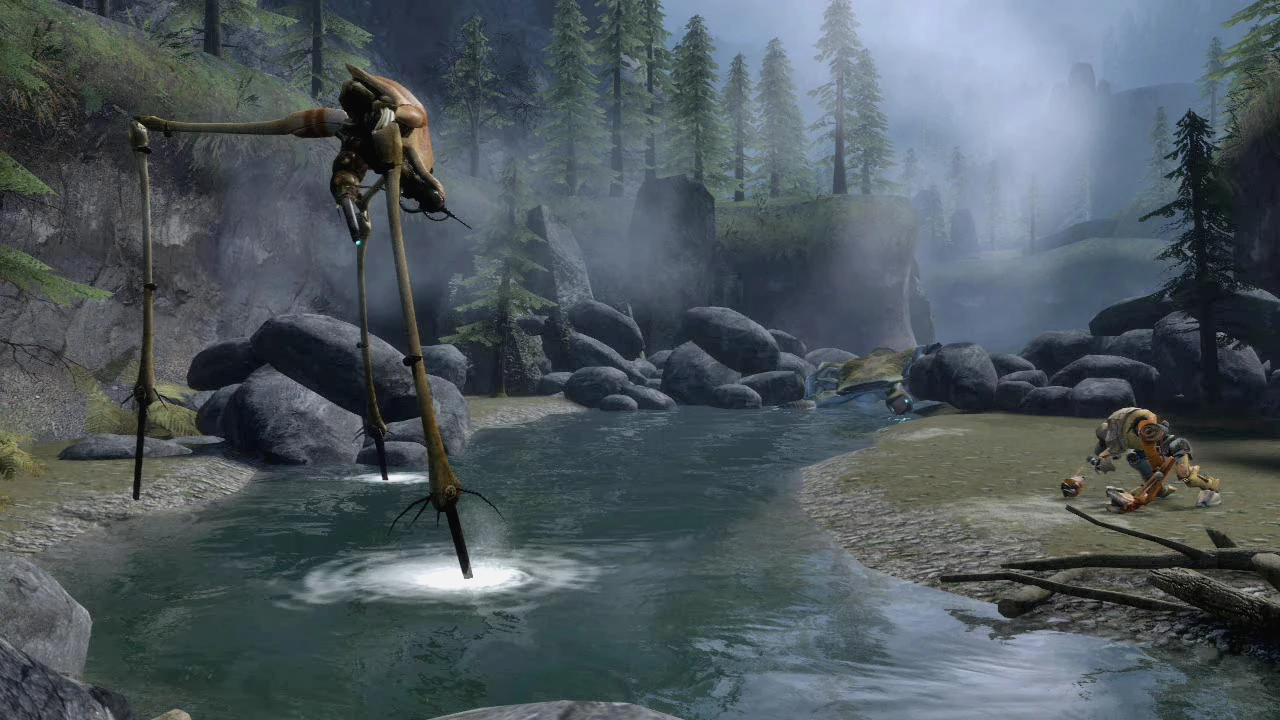
Dog challenging the Strider in the Episode Two trailer.
- In the Episode Two commentary, information is given about the spectacular battle between Dog and the Strider:
- According to Valve's Ken Birdwell, the Strider for the sequence with Dog was custom built, with large portions of it capable of being ripped off, and "goo" being spewed everywhere when it took damage. The custom Strider was used as a test bed for new modeling technology and Valve's new particle system introduced in Episode Two. Ken further adds that with the episodic production process of the HL games, a lot of new technology comes online throughout development. Since any new technology takes a year or more to really work out all the bugs, developers like to look for isolated areas - like this one - where they can test out new things without risking other elements of the game which they already know to be fully functional. Valve followed this same process with HDR in Lost Coast; once they were sure that new in-engine additions did not break anything, they were able to move the new features into general use. Since the new, custom iteration of the Strider performed well in the sequence with Dog in Episode Two, it will become the new Strider model used by Valve's development team as they move forward, and any new knowledge gained will be applied to new monsters in Episode Three.[4]
- Bill Fletcher adds that their main goal with that scene was to create "a cinematic battle of the titans", Dog vs. a Strider. While they were excited with the early implementations, it became obvious that players were uncertain of their role in the scene. Originally the confrontation built slowly with Dog squaring off against the Strider, but having such a slow beginning proved problematic. It looked good in the Episode Two trailer, but did not play well in the game. Instead of the slow build, the team decided to send Dog straight into action. He makes a grand entrance, jumps on the Strider and the fight begins. The quick start helps to grab the players attention instead of giving them too much time to worry about what they should be doing.[4]
- According to John Guthrie, the massive Strider battle near White Forest was in production longer than any other map in Episode Two. Tuning it required many, many months of testing and iteration to address playtest feedback, and this was complicated by the fact that every time the team playtested, they saw individuals adopt completely different approaches to defeating the Striders. Some threw logs at Hunters; others relied on their Rebel companions to kill them. Some players never sprinted, while others never used the car. They tried to keep supporting all the different strategies that occurred to players, so that their experiments with tactics would be rewarding rather than frustrating. Meanwhile, they had to make sure the Strider and Hunter behaviors were consistent, and balance the experience so that it would be a satisfying game experience for all different play styles at every skill level.[4]
- According to a comment section in Half-Life 2's source code, the Strider originally had a bug where its pulse cannon's damage per shot to NPCs was based directly on the ammo capacity (15), when it was assumed that original damage was 8. This was fixed in an update and finally fixed in Episode One. When shipping The Orange Box, the Strider's ammo was changed to 15 for Half-Life 2 and 5 for Episode Two.[6]
- The Strider battle in Half-Life: Alyx originates from a circa-2015 playtest where players were simply placed underneath a Half-Life 2-Strider. Satisfied that a Strider battle in VR would make for a worthwhile experience, the developers played with different ways of having the Strider stalk the player, be it shooting through cover or breaking through a wall.
- The scene of the two Combine soldiers investigating the de-activated Strider is designed to hint to the players the Strider may not actually be dead.
- Despite outward appearances, the Strider battle was originally designed around the idea of having the player cooperate with the Strider: in order to progress, the Player needs the Strider's help to clear obstacles, using the childrens' story The Lion and the Mouse as a metaphor. Most of this, along with an early idea of the Strider being trapped under an elevator before being freed, was cut although The Lion and the Mouse concept is still loosely used in the final game.
Related achievements
Half-Life 2

|
| ||
| Survive the rooftop Strider battle in the ruins of City 17. |

Half-Life 2: Episode Two

|
| ||
| Save all buildings outside the missile silo from destruction. |

|
| ||
| Save the missile silo from the Combine offensive. |
Half-Life: Alyx

|
| |
Earned after waking the Strider in chapter 10: Breaking and Entering.
|
Trivia
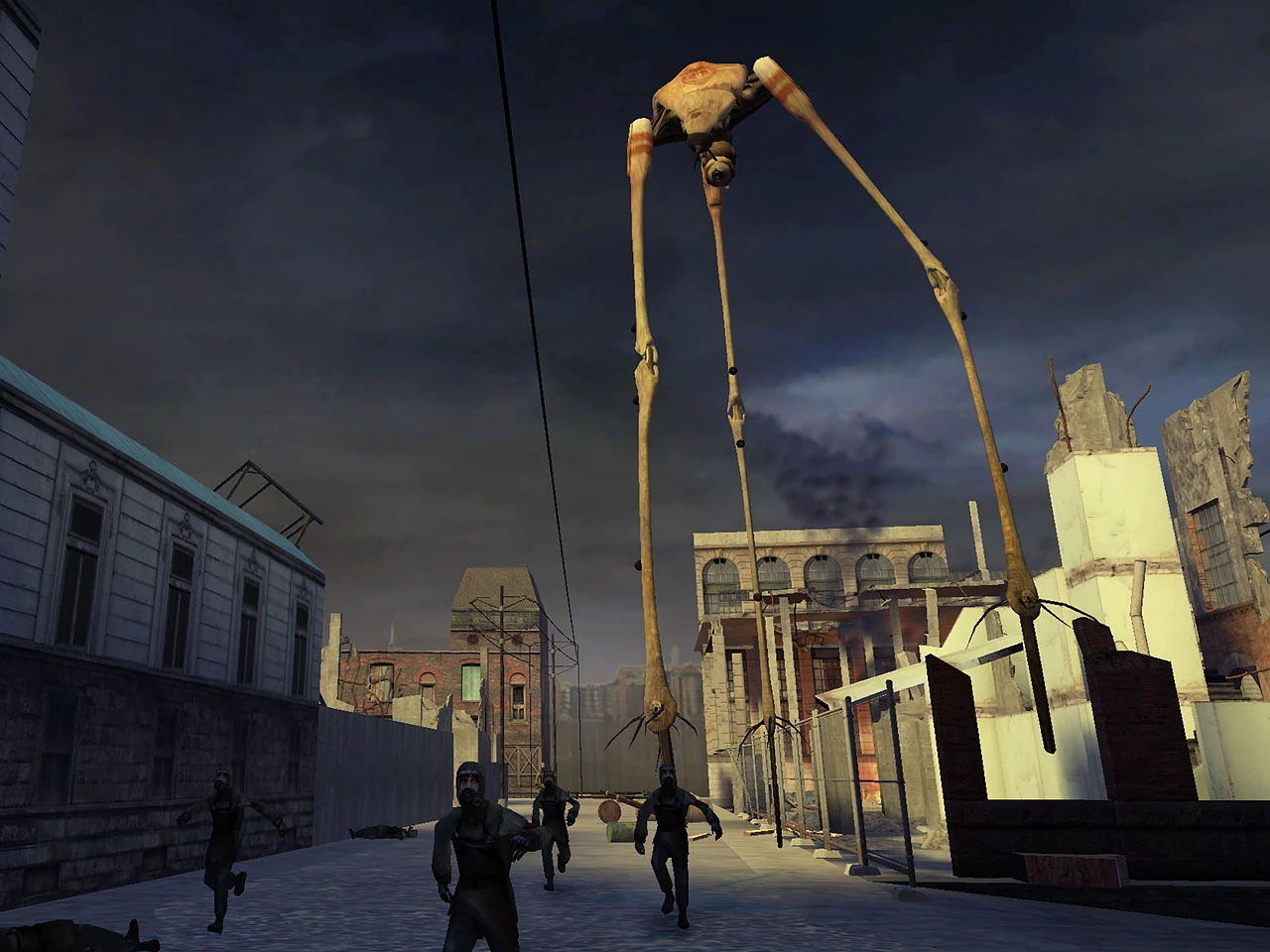
Gas mask Rebels fleeing a Strider in the map "e3_strider", in one of the earliest Half-Life 2 screenshots.
- The only way to spawn a Strider via the console is to activate "noclip", going up to at least the creature's height, and typing into the console "give npc_strider". It will not use its warp cannon and will only walk if the target moves out of its line of sight and if the map has the necessary node structure.
- Striders closely resemble the "tripods" described in H.G. Wells' The War of the Worlds, especially the warping cannon, which is very similar to the Heat-Ray from the aforementioned novel. Earlier Strider concept art further exemplifies the similarities. Just like the tripods, they make strange, beeping noises.
- The accuracy and rate of fire of the Strider's pulse turret was increased in Episode One but has decreased damage.
- According to the developer commentary, the behavior of the pulse turret is slightly modified to allow the player to fire a rocket at the Strider without taking damage. The Strider will fire a few moments then pause for a brief period, long enough for the player to guide the rocket to the Strider.
- The Strider has a strange method of firing with its pulse cannon, a variation of walking (that is, firing at a point near a target and slowly aiming towards it). It seems that when it focuses on a particular enemy, it fires a long string of shots: the first ones do not hit, but unless the enemy goes behind cover, the last few will always hit. However, this has been removed in Episode One, notably in the final Strider battle.
- An Orange Box Achievement, "Giant Killer", requires surviving the Strider battle at the end of the Half-Life 2 chapter "Follow Freeman!". The Episode Two Achievements are "Neighborhood Watch" and "Defensive of the Armament". They involve saving all the buildings outside White Forest and preventing the Striders from reaching the base, respectively.
- Gunships and Striders bear the same logo on their back and head, respectively. This logo was on the back of the Overwatch Soldier's old skin (in white) and can also be seen on the shoulder of one of the Combine Synth Elite Soldier versions. Its meaning and whether it is a Combine logo or not or if it proves a closer relation between the Gunship and the Strider are unknown.
- If Gordon fails to defeat all the Striders attacking White Forest, the last one will destroy the antenna in a single shot. Afterward, the message "The rocket has been destroyed - Magnusson's misgivings about the Freeman are completely justified. - The game now ends" is shown, and the game reloads.
- If a player playing Half-Life 2 uses cheat codes and fires a rocket at the Strider which walks past the opening square in City 17, the rocket will harm the Strider - however it will turn towards the player and glare for a moment before moving on. This also applies in Episode One after the underground.
- Knowing the Strider's offensive capabilities, they may have been used by the Combine during the Seven Hour War, possibly a more heavily armored variation.
- The Strider can be also heard in the ambience sounds, most notably "streetwar".
- In Half-Life 2 and its Episodes, Striders never use their legs to kill the player. However, if played in Garry's Mod, and the player gets too close, they will kill using their long legs (only the Striders that are spawned by the map, not the ones spawned by the players). Getting in the Strider's way may still result in death by stomping, however.
- This ability is shown and used during part of E3 2003.
Gallery
Concept art


Screenshots
Pre-release


e3_strider, as seen in the first Half-Life trailer.
e3_strider.
e3_strider.
e3_strider.
e3_end" and "hazard01".
Half-Life 2


Episode One

Episode Two


List of appearances
- Half-Life 2 (First appearance)
- Half-Life 2: Raising the Bar
- Half-Life 2: Episode One
- Source Particle Benchmark (Game files only) (Non-canonical appearance)
- Half-Life 2: Episode Two
- Half-Life: Alyx
References
- ↑ Half-Life 2 Prima Guide
- ↑ 2.0 2.1 2.2 2.3 2.4 2.5 2.6 2.7 2.8 Half-Life 2: Raising the Bar
- ↑ Half-Life 2 Beta source code
- ↑ 4.0 4.1 4.2 4.3 4.4 Half-Life 2: Episode Two commentary
- ↑ Half-Life 2 E3 2003 Trailer
- ↑ Half-Life 2 source code


